
A Doctor’s Diet
The past couple weeks I discussed my addiction to carbs sugar sweets and my concerns about how poor diet and exercise are reflected in my weight trends.
This week I’m going to delve a little more into ups and downs of my weight, provide my cholesterol data, and discuss strategies for better health.
This is Part III in a three-part series. Read Part I and Part II.
Back To The Graphs
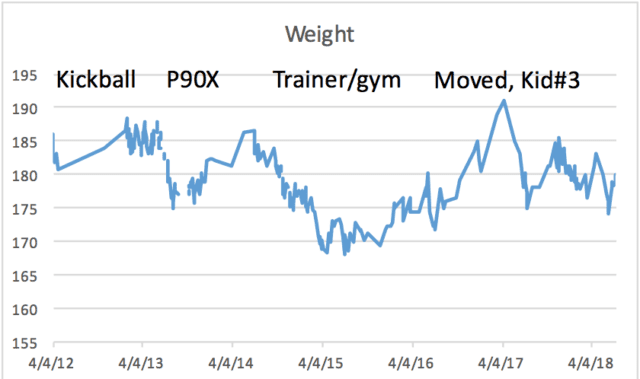
Last week I showed the multi-year graph of my weight going back to 2012. The weight starts around 180-185 and has vacillated up and down around that number for the entirety I have tracked the data. Here is a graph with a few labels:
-
- 2012 — I was playing rec league kickball, which you can see did little for my weight. Going out to eat late at night after every game didn’t help
-
- 2013 — My P-90X phase — this home video workout was extremely popular several years back (and perhaps still is, though no one talks about it anymore). It involves a lot of cardio, a little yoga (which I hated), and some resistance movements. I improved my fitness level, but I never looked like the guys in the videos.
-
- Late 2014 through mid 2016 — I joined a 24-hour gym (located <0.5 miles from my house) and worked with a personal trainer for lengthy stretches. You’ll notice a spike in weight in summer of 2015 — my exercise regimen fell apart during Ramadan, though I was able to recover to a large degree after Ramadan ended. I aggravated an old neck/shoulder injury in spring 2016, significantly impairing my ability to exercise.
-
- June 2016 — with kid #3 due in September and needing a larger space, we moved to a new house. We moved right at the beginning of Ramadan. In case you didn’t know, moving to a new home when it’s 100 degrees and fasting for 18-hours at a time is sub-optimal. I completely stopped exercising, my nutrition fell apart, everyone was stressed, and it was general yuckiness for a several month period. This is when my weight hit all-time highs (190+).
-
- June 2017 — Thanks to Ramadan my weight came back down, but my overall health and fitness were not any better. I joined the local community center to access the gym and began intermittently exercising on my own. My cardiovascular fitness improved a little but it wasn’t great
-
- Fall/Winter 2017-18 — I ate a lot of food in the fall (like, several pounds of pumpkin pie). I joined a rec league soccer team in the winter and by the final game could run without feeling the need to puke. Unfortunately I broke a finger in the final game. The fracture was minor, but the ligament damage I sustained is still causing swelling and pain 5 months later, though it’s not interfered with my work/daily life. Oh yeah, I also got mono during the winter, so that sucked.
-
- Present day — Ramadan finished a month ago. My weight dropped but rebounded almost as soon as the month ended, despite not eating exorbitant amounts. Dehydration probably accounted for some of the weight loss.
The Yo-Yo
This up/down phases are probably similar to what many people have gone through. The only sustained phase where I was in good shape, regularly exercising, and improving my overall health was when I worked with a trainer.
Sign up to receive email notifications of posts. Follow me on X, Facebook, or Instagram for entertainment and updates of new posts. Feel free to email me with comments, questions, or to ask about site sponsorship or public speaking.
The trainer gave me accountability and purpose. We set goals and he was able to push me harder than I would work out on my own. I think that’s similar to many people.
I think we underrate the impact good coaching can have when it comes to exercise and nutrition. I’m not an athlete, but even the most talented and driven professional athletes rely on coaches to both help them reach their potential and maximize their effort. Those of us with less talent (and less motivation) may benefit even more from coaching.
The Cholesterol Numbers
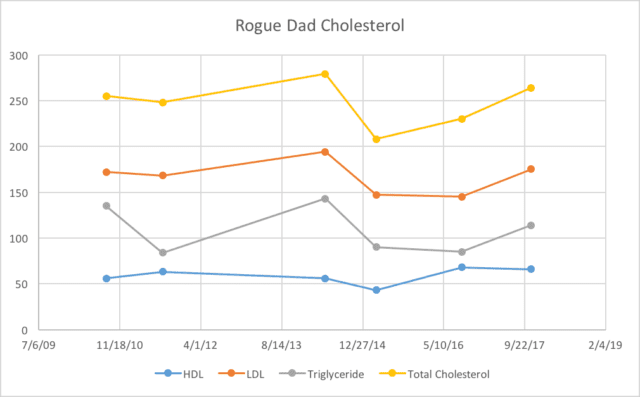
Between insurance physicals and checkups with my doctor I was able to track down 6 times in the past 8 years I’ve had my cholesterol checked. The top line (yellow) is total cholesterol, the red line is LDL (bad cholesterol), the gray line is Triglycerides (more bad fat), the blue line is HDL (good cholesterol). You can correspond this with the weights on your own if you would like, but there’s really two stories:
One
In 2014 my total cholesterol was really high during an insurance physical. Later that year I went and saw my primary care physician for a routine checkup. Given my young age and lack of significant other cardiovascular risk factors, he wasn’t worried. I was worried so I made a bargain with him and myself — get the numbers better or start on medication to lower it. He agreed to indulge me.
That’s when I joined the gym and started using the trainer. My total cholesterol dropped from 279 to 208 and my LDL dropped from 194 to 147. I was eating better (tracking it in the MyFitnessPal app) and overall just much healthier. I “won” the bargain and avoided needing medication (that my doctor didn’t want to prescribe anyway).
Two
In 2016 we moved and my fitness and nutrition went to crap, as mentioned above. My cholesterol levels have worsened overall since then, though my HDL has gone up (which is good). Right before my last cholesterol check in 2017 I ate 5 pounds of pumpkin pie, so that didn’t help.
My primary care doctor continues to not be concerned, but I’ve become more concerned. It’s become harder to dedicate time to exercise as time demands go up from children/work, and there’s no option as cheap/accessible as the 24-hour gym I used to use regularly. That is a solvable issue if I pay more money and spend more time coordinating time to exercise.
More importantly, that far-away future where high cholesterol is dangerous enough to cause a high risk of things like heart attacks creeps ever closer. I’m still young in the sense that the odds of having a stroke or heart attack in the next 5-10 years are exceedingly low, but it’s not zero. I would like to drive down those odds significantly.
Let’s Get Physical
Another Ramadan has passed and I decided it’s time to re-dedicate myself to … myself. And my health.
I joined a gym that focuses on using circuit training and kickboxing to do high-intensity interval training (HIIT). If you’re not familiar, this is basically what every modern workout focuses on. The science says it’s the best way to increase fitness and health in a short period of time, and may offer as much benefit as extended workouts. I.e. Sprints with short rests spaced over 10 minutes may be as good or better for you than running for 45 minutes.
My wife has been doing this for close to a year and is feeling (and looking!) great, so I decided to dip my toes in the water. I had been trying to do HIIT workouts on a treadmill at the rec center gym, but I can’t push myself on my own as much as I am pushed in this real workout (where my heart rate is 150-180 for 30 minutes).
This workout is composed of 9 stations (“rounds”) — the first one is always jump rope. The other ones change a little every day. I had not used a jump rope since elementary school — holy s*** it is exhausting. I did not remember this at all from childhood. I have enormous respect for all boxers, as well as the lady 20 years older than me who I saw working out last week and was practically doing cartwheels while jumping rope.
I’m trying to figure out the nutrition aspect. At my “peak” a few years ago I was tracking literally every calorie in my smartphone app and focusing on hitting certain protein, carb, and fat goals, as well as not exceeding a certain caloric intake.
It worked, but it’s hard to do that every day on your own, and I’m not sure I have the energy to do it again.
My friend, G.A., encouraged me after reading my latest blog post to try the ketogenic diet. 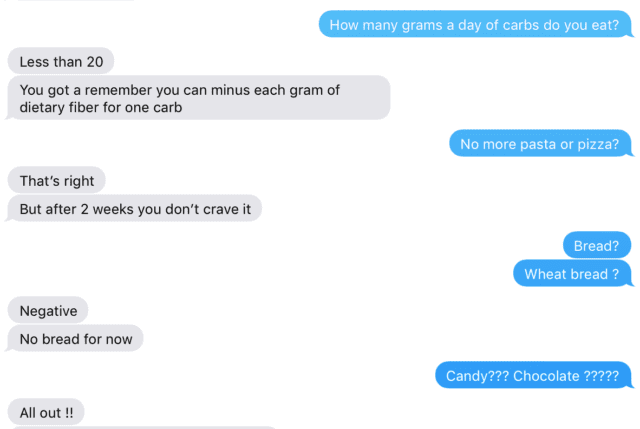 My first introduction to this was as an intern in pediatrics. I met patients with intractable epilepsy on the diet — the severe carb restriction reduced their seizure frequency.
Apparently everyone else has realized carbs are bad, because now we’ve decided it’s a great way to lose weight. Actually, the Atkins diet already had people eating a lot of protein and eliminating carbs. Atkins was a “fad” but the ketogenic diet is apparently for real. I frankly haven’t spent the time to decipher how they are different.
Apparently my breakfast this morning doubled the allowed carbs for the day. So I doubled down.

I’m not sold on carb restriction as a long-term answer. I am sure I can drop 10 pounds doing it, but I am not sure it’s sustainable, nor am I convinced it’s the “key” to long-term health. While it may not be as straightforward as the “use more calories than you eat” approach we’ve mostly been taught, it’s hard to know the best approach.
Intermittent fasting is another potential nutrition option that is endorsed both my my keto-friend G.A. as well as others I know. I’ve already proven to myself I can go 18-hours with no food or drink because of Ramadan. This “diet” takes that and makes it a lifestyle where several days of the week you significantly calorie restrict, and the other two days you eat whatever you want.
I think this may have more legs to it than keto, paleo, Atkins, etc. I’ve noted before how every year after fasting for Ramadan I re-learn I do not need to eat as much as I’ve trained myself to eat. I believe this has legs because I’ve been fasting for 25-years and learning this every year, but then not translating it into a formal plan. Intermittent fasting basically takes those lessons and makes it a lifestyle.
The Goal
Sure, the ultimate goal is to eat helathy, exercise plenty, sleep 8-hours a day, and have my cholesterol numbers drop and my overall health improve. I have a hard time envisioning giving up pumpkin-pie, so the ketogenic diet is probably not going to work long-term.
It’s possible that even with good exercise and nutrition habits I will end up on cholesterol lowering medication. Even at the best number’s I achieved (in 2015) they weren’t great, so it’s possible my South Asian genetics are going to doom me to taking some medicine anyway.
If that’s what happens, so be it. The real goal is to be healthy, active, and of course, stay alive a long-time. I’ll use whatever combination it takes to get there.
This is Part III in a three-part series. Read Part I and Part II.




I commented on your last post and am continuing to follow along. Sometimes the answer is right in front of us but we can’t see it! Just as working with a trainer keeps you accountable with your fitness goals, perhaps working with an Intuitive Eating coach or nutritionist could help you learn to honor your hunger and get off the diet train. Here is some information about diets, they don’t work!
https://www.muscleandstrength.com/articles/5-things-diet-gurus-dont-want-you-to-know
Hi Mary
Meeting with a nutritionist is a good thought, though what I really need is a coach. I understand the nutrition and know what to do in most cases, but it’s maintaining effort/focus that is hard (I’m no different than anyone else). A coach of some kind is more likely to help. When I worked with a personal trainer a few years ago we did discuss nutrition at the same time which gave me reminders, which I don’t get now. I don’t ever follow fad diets, but something’s do need to change in mine. I’ll check out the website
Dude. I am impressed by your resolve. I say I am going to cut out carbs, and there I am an hour later eating a sandwich. I really think carbs and sugar are the most addicting things for humans.
As for cholesterol, weight and overall health, I think it gets much harder after 40. So starting now is the way to go. Your 60-year-old body will appreciate it. I would say adding stretching becomes important to avoid aches and pains of aging too.
As for my work out routine, it consists of yoga and trying to eat healthily. It does not always work as I ate about 30 peanut m and m’s yesterday.
My “keto” diet effort thus far has gone about a day before I eat something that is 30g carbs and it’s all over. However I have noticed when I am low carb how irritable I get really quickly — I don’t think that’s healthy for anyone.
Re stretching, you are the yoga guy. I don’t mind stretching pre workout and afterwards but I am doomed to be a twisted old man with my lack of flexibility and dislike of yoga like stuff.
I went super low carb while working out like crazy to prep for my wedding a few years ago and let me tell you the no carbs thing definitely takes a toll on the mood. We were waiting for our evening flight at the airport and after some delays I was exhausted (even after coffee) and grumpy and irritable and all around not fun to be around. So my then fiancé picked us up a treat of m&ms after our second delay announcement and I swear, after 5 of those bad boys I felt like a whole new person. And now, almost 2 years later, I find myself trying to go back to cutting carbs. My poor husband 🙂
It’s absolutely true — when you’ve been carb deprived (or calorie deprived in general), just a small amount makes you feel amazing. It does make me realize I eat far more carbs than I *need* — but I am not convinced a keto diet is a really healthy or long term solution.
Have you considered going on a Blue Zone style, whole food plant centric diet? I know a lot of people are quick to discredit it but you can’t knock it until you try it.
I think it’s worth a good try in order to reduce your cholesterol numbers. It would be awesome if you can prevent yourself from having to go on cholesterol lowering drugs. Muscle pain from status can be a real drag.
Anyway, that’s the diet I’ve followed for the past two years and it has really reduced my cholesterol and LDL levels. I have lost excess weight (fat around my waist), have more energy, and I feel great too.
I’d encourage you to give it a try!
I’ve not actually heard of the Blue Zone approach so just did a quick read. It makes sense — sounds like it basically boils down everything to what we know is best. Eat lots of veggies/fruits and minimize intake that’s become a staple of “modern” diets. I think eating more veggies is one thing I’ve never made a big improvement in — I’ve done a good job at various times with everything else. It’s something to consider.